

Elon Musk’s Starlink’s bid to enter India, a market of over 1.3 billion people and one of the major connectivity frontiers for Low-Earth Orbit (LEO) satellite broadband, is facing another regulatory challenge, as the Indian government has put the company’s Foreign Direct Investment (FDI) proposal on hold amid escalating national security concerns tied to shifting global geopolitics, as per a report in Economic Times.
People with direct knowledge of the matter told the publication that Starlink’s FDI application is currently frozen and could be rejected outright if the company fails to adequately address queries raised by Indian authorities. The concerns center on cross-holding structures within parent company SpaceX and a set of technical parameters that the government has not publicly disclosed. Senior Starlink executives are expected to meet Commerce Ministry officials later this month or in early May to attempt to resolve the impasse.
The development is a significant blow for Starlink, which has been trying to enter the Indian market since 2022 and had appeared to be closing in on a commercial launch after securing a GMPCS licence from the Department of Telecommunications and an authorisation from the Indian National Space Promotion and Authorisation Centre (IN-SPACe). Those approvals, it turns out, are necessary but not sufficient. Without spectrum allocation and clearance on both FDI compliance and national security grounds, commercial operations cannot begin.
The Security Calculus
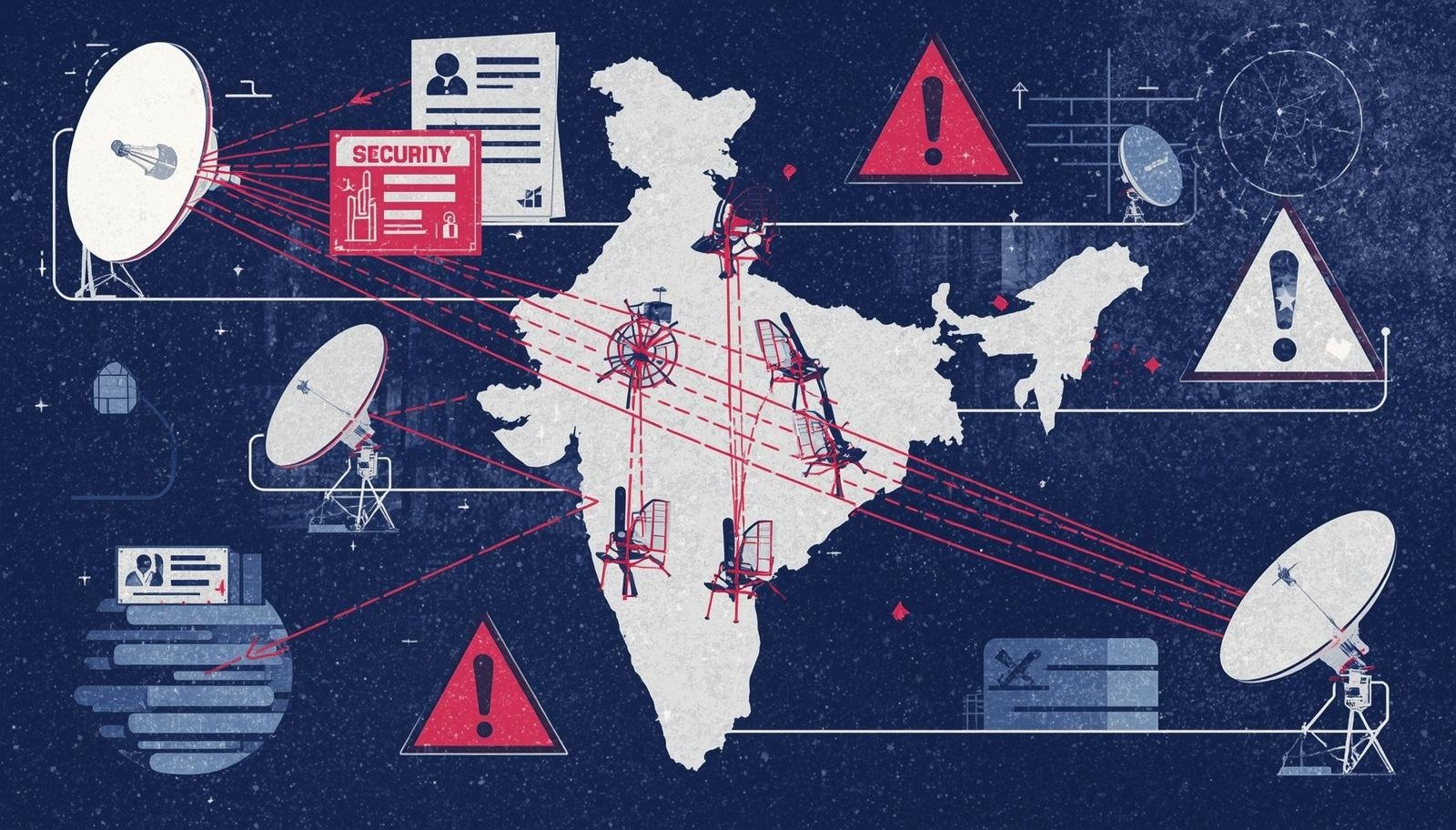
At the heart of the delay is a concern that goes beyond routine regulatory procedure. India’s security establishment has grown acutely wary of satellite communication networks, which by their nature operate beyond physical national boundaries and are difficult to interdict once operational.
The anxiety has been sharpened by a specific international incident: during the ongoing West Asia conflict, Starlink terminals were found to have been used inside Iran despite a government-enforced ban — an episode that sent alarm signals through India’s intelligence and security community. The incident demonstrated that the practical reach of a satellite internet service can be significantly harder to control than its legal boundaries suggest.
While Indian authorities are not anticipating a comparable scenario domestically, the fact that a foreign-operated satellite network could become a security liability in a crisis is pushing them to adopt a more cautious approach.
A Regulatory Tangle Around FDI and Cross-Holdings
India’s FDI policy technically permits 100% foreign investment in satellite communication services. However, automatic government approval applies only up to a 74% stake, anything beyond that requires explicit government clearance, placing Starlink squarely in review territory given SpaceX’s full ownership of the entity.
The complexity is compounded by cross-holding norms that apply to entities in the space and telecom sectors, and by a requirement under India’s space policy that any foreign company seeking FDI approval must operate through an incorporated Indian subsidiary.
These are not novel regulatory requirements, but their application to a company with SpaceX’s ownership structure, itself a privately held entity with a complex investor base — has created interpretive questions that neither side appears close to resolving.
A Market Worth the Wait — and the Fight
The stakes for Starlink are considerable. India is the world’s second-largest smartphone market by subscribers, with over 1.32 billion telecom connections and broadband penetration exceeding 1.06 billion users. Yet vast areas of the country, including hilly terrains, island territories, tribal belts, and remote agricultural districts, remain beyond the reach of viable fibre or terrestrial mobile infrastructure.
This is precisely the gap that low-earth orbit satellite broadband was built to fill. Starlink’s global network, now operational across more than 100 countries, offers download speeds of 50–200 Mbps with latency in the 20–40 millisecond range, performance that rivals fixed broadband in many rural contexts and significantly exceeds what existing VSAT-based satellite services in India can deliver.
The Indian government, for its part, has publicly committed to expanding rural broadband through the BharatNet programme, which aims to connect gram panchayats through fibre. But BharatNet’s rollout has faced chronic delays, and satellite broadband — if commercially available — would offer a faster, infrastructure-light alternative for hard-to-reach communities. The potential market for satellite broadband in India is estimated in the hundreds of millions of underserved users, a prize that has drawn not just Starlink but also Jio-SES, Airtel-backed Eutelsat OneWeb, Amazon’s Project Kuiper, and Viasat.
A Crowded Field, an Uneven Playing Field
Starlink is not the only player waiting for India’s satellite broadband market to formally open, but it is the one facing the most friction. Eutelsat OneWeb, backed by Bharti Airtel, and Jio-SES, a joint venture between Reliance Jio and Luxembourg-based SES, both hold licences and have been positioning for commercial launch. The domestic ownership and partnership structures of these players have given them a smoother regulatory path than Starlink’s purely foreign-owned model.
The spectrum allocation question adds another dimension. TRAI, India’s telecom regulator, released a new consultation paper earlier this month seeking stakeholder views on the framework for satellite communication network authorisation and spectrum assignment — including the contentious question of whether satellite operators should be permitted to use conventional mobile spectrum bands (4G/5G) for direct-to-device connectivity. Comments are due by May 6. Until that regulatory architecture is finalised, the spectrum Starlink needs to operate commercially remains unallocated across the board.
The broader satcom spectrum debate, over whether satellite operators should pay licence fees comparable to terrestrial mobile operators who invest billions in spectrum auctions — remains live and politically charged. India’s major telcos have argued vigorously for fee parity; satellite operators, including Starlink, contend that satellite spectrum is a shared global resource and should not be auctioned. The government’s decision to administratively allocate satellite spectrum, rather than auction it, resolved one dimension of this debate, but the commercial terms remain under discussion.
What Comes Next
The meetings expected between Starlink executives and Commerce Ministry officials in late April or early May will be a critical test of whether the company can navigate the twin obstacles of FDI compliance and security clearance. If it cannot, India joins a short but consequential list of major markets where Starlink’s ambitions have been constrained by national interest considerations.
For India, the question has a sharper edge. A market that has publicly committed to universal digital connectivity will need to resolve the security caution to realise its connectivity ambitions. Satellite broadband, with its capacity to reach the yet-to-be-connected areas, may be too valuable a tool to leave unused indefinitely, regardless of who owns the satellites.