



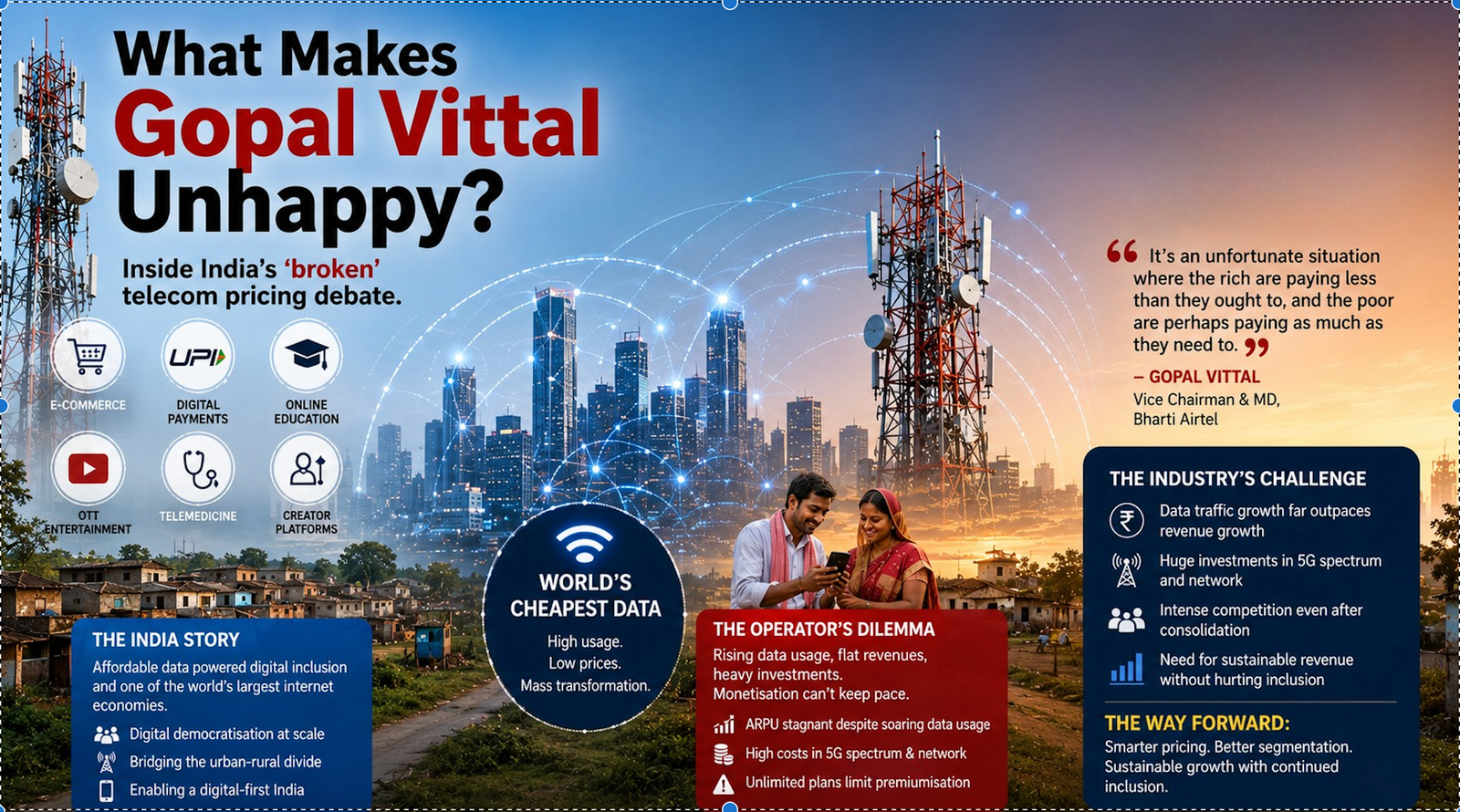
India’s telecom industry has long celebrated its achievements in offering one of the world’s cheapest mobile data while bringing hundreds of millions online. But if one listens closely to Gopal Vittal, Executive Vice Chairman of the country’s second-largest service provider, Bharti Airtel, there is another narrative emerging beneath the success story, that of growing frustration.
“The price architecture in this country is broken,” Vittal said during Bharti Airtel’s latest earnings call, repeating a concern he has raised consistently over the past few years. At the heart of his argument is India’s unlimited-data ecosystem, which offer significant benefits, so much so that more users don’t need to upgrade to higher data packs. What this means is that the subscribers often pay nearly the same amount regardless of how much data they consume.
According to Vittal, this has created a distorted market. Heavy users consume enormous amounts of data but contribute little additional revenue, limiting operators’ ability to improve Average Revenue Per User (ARPU). “It’s an unfortunate situation where the rich are paying less than they ought to, and the poor are perhaps paying as much as they need to,” he remarked.
From Airtel’s perspective, India’s telecom market has become too flat. Whether a customer consumes moderate data or several hundred gigabytes every month, pricing differences are marginal. Vittal believes the industry needs stronger premiumisation and more layered pricing structures, similar to those in many developed markets.
The concern is not without reason. Indian telecom operators have collectively massively acquiring 5G spectrum and building networks. Yet unlike earlier technology upgrades, 5G has not translated into proportionately higher revenues. Instead, unlimited data offers have reinforced consumer expectations around abundant low-cost data.
As data consumption surges due to growing popularity of video streaming, gaming, AI applications and cloud services, operators are struggling to ensure monetisation keeps pace with network investments. Airtel’s recent launch of Priority Postpaid, a 5G-powered network slicing service promising a more stable experience during network congestion, is part of its broader attempt to create premium differentiated offerings.
But while telecom operators argue that India’s tariff structure is unsustainable, there is a counter argument that low prices may actually be the foundation of the country’s digital transformation.
Cheap mobile broadband helped transform India into one of the world’s largest digital economies within a decade. Affordable internet accelerated the adoption of UPI, ecommerce, telemedicine, online education, OTT platforms and creator ecosystems. Millions of first-time users entered the digital economy because connectivity became inexpensive and widely accessible.
In that sense, India’s telecom market may not be “broken” at all. Instead, it may represent a successful examples of digital democratisation. The affordability factor becomes even more significant in a country marked by wide income disparities. Low telecom tariffs acted as a social equaliser, enabling access to digital services for rural and lower-income populations that were previously excluded from the internet economy.
This is why the telecom industry’s push for aggressive tariff hikes or stronger segmentation remains politically and economically sensitive. For instance, there have been concerns regarding net neutrality around Airtel’s recently launched Priority Postpaid and the service provider has recently submitted its stance to the Department of Telecommunications (DoT). Last year, there were concerns when the service providers discontinued a few basic plans. Higher prices could slow digital inclusion in a country where internet access is increasingly tied to education, commerce and government services.
Still, the operators’ frustrations cannot be dismissed entirely.
India remains one of the few large telecom markets where data traffic growth consistently outpaces revenue growth by a significant margin. Networks require constant capital expenditure, particularly as 5G usage rises and AI-driven applications increase bandwidth demands.
At the same time, the market has undergone massive consolidation. After years of brutal price wars, India effectively became a three-player private market dominated by Reliance Jio, Airtel and Vodafone Idea, alongside state-owned BSNL. Yet despite consolidation, operators remain cautious about pricing because of intense competition and subscriber sensitivity.
This creates a paradox: India operates some of the world’s largest and fastest-growing telecom networks, but revenue monetisation still lags many international peers. The debate also reflects a larger shift within the telecom industry itself. Operators increasingly want to evolve beyond connectivity providers into digital service companies offering cloud, enterprise, AI and platform-based services. That transition requires stronger monetisation models.
Ultimately, Vittal’s criticism highlights a deeper question: what should India’s telecom market optimise for?
If the goal is universal digital inclusion, ultra-low tariffs remain a powerful national advantage. But if the goal is long-term telecom sustainability and stronger returns on infrastructure investments, operators will continue pushing for higher ARPU and premium pricing models.
The likely answer lies somewhere in between — gradual tariff increases and smarter segmentation without undermining the affordability that powered India’s internet revolution in the first place.
What remains clear is that the debate over India’s “broken” pricing structure is no longer just about telecom tariffs. It is about how the country decides to balance digital inclusion, network economics and the next phase of its digital ambitions.