

– By Udit Verma, CMO, Apptrove
“Technology evolves. Customer expectations accelerate. Sustainable growth comes from understanding the relationship between the two.”
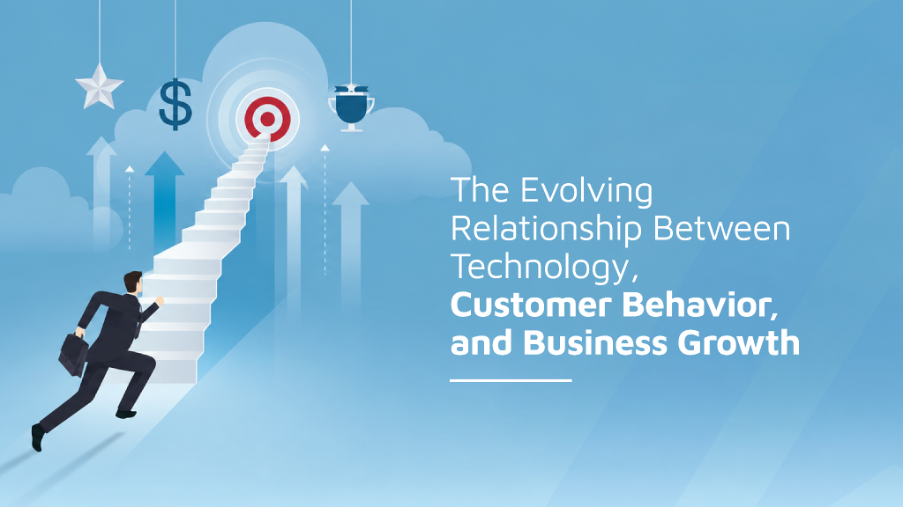
Historically, businesses have treated technology as a functional area of operations, customer behaviour as a marketing issue and growth as measured by revenue and expansion. Today, there is no longer a distinction between those areas.
Technology is a major influence on what customers expect from a business’s products and services. At the same time, customer behaviour is a major influence on the decisions that businesses make about their operations. Consequently, more than ever before, growth will depend on how well an organisation connects technology and customer behaviour. Every time a customer clicks, searches, or makes a purchase, that interaction creates a signal. Organisations that develop sustainable growth are not about collecting the maximum amount of data possible, but rather understanding customers better.
The Convergence Economy
At this time, our global landscape has changed significantly. Everything we do as businesses and customers today is impacted by central themes of technology, consumer behavior, and business strategy. As such, any new technological advancement can cause a sudden and complete shift in the expectations that consumers have based on those e-commerce and/or technology advancements. When consumers’ expectations change so drastically and rapidly due to innovation, businesses must quickly adapt their products, services, and/or customer experiences based on what those consumers expect.
Today’s leading organizations no longer think of technology merely as a tool to assist them. Today’s organizations think of technology as a way to gain greater customer insight and adapt more effectively to their changing needs.
“In the past, successful companies thought of technology as a tool; today, they think of it as a lens into the minds of consumers.”
A New Way to Create Customer Experience: Building Blocks of Technology
The technology revolution has changed the way people expect convenience. Today’s customers don’t see seamless experiences as a reward; rather, they view them as a given.
According to research conducted by experienced experts, approximately 80% of consumers regard the experience provided by a company as equally important as the product and/or service provided. This means that businesses are no longer competing for the best product or the lowest price. They are now competing for the best experience.
Every time a customer has an interaction with your company, they compare that experience to the best experience they have ever had, regardless of the source. Therefore, the point of reference is not simply your closest competitor; rather, the point of reference is the expectations of consumers.
“Customers no longer use their competitors as a standard. They use their expectations as the standard for all companies.”
The Insight Deficit
In the current age of business, we have an abundance of data, but many companies cannot fully comprehend who their customers are. We are interacting daily and creating information from those interactions, as well as collecting metrics from platforms like websites and social media; furthermore, the data captured during the digital journey of customers contains so many usable signals.
Finding the ability to gather data is not a long-term challenge; however, understanding data has proven to be a greater difficulty. We use dashboards to learn what occurred; utilize analytics to see a trend, and utilize reporting to measure our outcomes. None of these explains why customers make the purchase decision they do: hence, the source of true value is to know their motivation behind the behaviour.
“Growth never occurs as a result of having more data; understanding what the data is saying is what causes growth.”
The Attention Economy Meets the Trust Economy
Companies that achieve substantial growth are the ones that turn all of their collected information into data that generates value, and then use that understanding to produce action for their business plans.
As we see in the Attention Economy, gaining any one person’s attention is extremely difficult and can take anywhere from a few seconds to a lifetime of “attention”, however, the Attention Economy has changed: obtaining an individual’s “trust” is now a significant factor in the choice of buying decision.
A survey of consumers shows that over 90% of them read reviews before deciding to make a purchase. More and more, the way people evaluate different brands has shifted from comparing products only to relying on others’ recommendations, social proof, and authentic experiences. Technology helps businesses reach audiences. Trust determines whether those audiences become customers.
“The strongest brands are not built on visibility alone. They are built on credibility earned over time.”
Human-Centric Growth in an Algorithm-Driven World
Artificial Intelligence (AI) is at the forefront of growth in the relationship between technology, consumer behavior and innovation. By 2030, it is predicted that AI will generate trillions of dollars for the global economy; Although much of the conversation currently around AI is focused on automating processes, its primary value is in assisting businesses in more effectively understanding their customers.
AI has the ability to identify patterns; process large amounts of information at scale; and provide insights into the needs of consumers that are otherwise obscured. AI will give organizations the ability to anticipate the needs of consumers; tailor marketing efforts to individuals; and provide them with a more informed decision-making capability.
“Technology will give us the ability to see more clearly through the way we use it, and understanding our consumers will give us the ability to accomplish more as an organization. The businesses that accomplish both will lead the market in the future.”
Moving forward into the next era of growth, the businesses that will be most successful are those that leverage technology as a means to gain a better understanding of their consumers. Even as we move into an increasingly algorithm-based world, understanding the consumer will remain the single biggest key to achieving a competitive advantage.